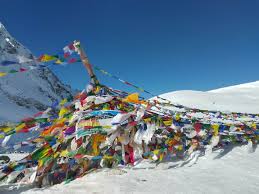
The Larkya La pass at 5,160 metres is the high point of the Manaslu Circuit and the day that decides whether your trek succeeds. We've crossed it 50+ times across both seasons. Here's what actually happens, hour by hour, with the failure modes and how to avoid them.
The night before
You're at Dharmasala (also called Larkya Phedi), 4,460 metres. Two lodges only — Jambala Guest House and Larkey Guest House. Both fill by 14:00 in peak season; arrive by lunchtime or you sleep in the dining hall. Pack the duffel for the porter the evening before — no headtorch fumbling at 04:00.
Eat dinner by 18:30. Dal bhat with extra rice; this is the wrong meal to skip. Drink one full litre of water with dinner. Layer in your sleeping bag with the base layer you'll wear in the morning — saves time and the bag warms it overnight.
Set the alarm for 03:30. Trust me, not 04:00.
03:30–04:30 — Wake and walk
It's -10 °C outside the bag, -3 °C inside the room. Get the down jacket on before you swing your legs out. Tea + biscuits in the dining hall — lodges have it ready by 03:45 in season. Don't try to eat porridge; your appetite is gone at this altitude and forcing food makes the headache worse.
Headtorch on, layered up (base + fleece + insulated mid + down + hardshell), liner gloves and mitts, balaclava. Step outside. Stars. -15 °C. You can see headtorches already moving on the trail above the lodge — start walking.
04:30–07:00 — The initial climb
First section is a steady moraine climb, +400 m gain over 2.5 hours. Pace is slow — 50 steps, 30 second rest, repeat. If you're out of breath, you are walking too fast. The 30-second-rest rhythm is the trick that gets normal trekkers over this pass without AMS.
Sunrise hits the peaks around 06:00 — Naike Peak, Larke Peak, Manaslu glowing pink over your shoulder. Most people stop here for photos; budget five minutes, no more. The longer you stop, the colder you get, the harder the rest of the day.
07:00–10:00 — The traverse and the false summits
The trail levels out across a glacial moraine for ~2 hours. Loose rock the whole way — rolled ankles are the #1 injury here, not AMS. Trekking poles are non-negotiable.
You'll see three false summits before the real one. Every one of them looks like the pass. Set your watch for the next 30 minutes and don't look up at peaks — just walk.
Microspikes go on if there's fresh snow or icy patches. November-April this happens regularly; rent in Kathmandu for NPR 200/day per pair, weight is 400 g. The few times we've sent trekkers without them in mid-November, they slipped within the first 100 m on the descent.
10:00–10:30 — Larkya La summit (5,160 m)
The actual pass is unmistakable when you arrive — prayer flags, cairn, plummeting drop on the far side, full panorama of Himlung Himal (7,126 m), Cheo Himal (6,820 m), and the Annapurna II massif to the south. The view back at Manaslu (8,163 m) is the trek's defining photo.
Stay 20 minutes maximum. The wind tears across the pass at 30-50 km/h every season; windchill is brutal. Eat a Snickers, drink water (insulated bottle — yours has been freezing in your daypack), photos, descent.
10:30–14:00 — The descent (the bit nobody warns you about)
This is the part of the day everyone underestimates. 1,400 metres of descent, mostly on loose scree, in 3.5 hours. Knees take a beating. The first 200 m off the pass is steep enough that two people from our 2024 groups fell here (no serious injuries, but bruised ribs).
Trekking poles tightened short for downhill. Microspikes stay on for the first hour. Take the switchbacks rather than the straight scree shortcuts — looks slower, is faster, no rolled ankles.
Halfway down, the gradient eases at a yak pasture (~4,400 m). Stop here for 10 minutes. Snack, water, sun cream re-applied (UV is brutal on the descent — your face is fully exposed). The temperature shift between -15 °C on the pass and +15 °C in the sun on the descent is the most-discussed weather feature of this day.
14:00–16:00 — Into Bimthang
The trail enters a beautiful open valley with glacier-fed streams. Bimthang at 3,720 m appears at the end of it — multiple lodges visible from 40 minutes out. Hotel Ponkar is the largest; Yak Lodge has the best Manaslu views. NPR 1,000 for a twin with attached.
By the time you collapse on the bed your watch reads 8h 30m walking time, ~14 km, +700 m and -1,440 m. You've crossed the highest pass on the trek and the worst is behind you.
The failure modes
AMS on the climb (~30% of unsuccessful crossings). Symptoms: headache scoring 4+ on the AMS checker, nausea, ataxia. Treatment: descend. Period. The closest help is Samdo 4 hours back — do not push on hoping to summit.
Hypothermia on the descent (~20%). You're sweating from the climb, the wind starts on the summit, you have damp base layers. Strip the wet layer at the pass, dry base on, down on top. We've evacuated three trekkers from the descent for hypothermia in the last five years — all three had insisted they were fine at the summit.
Rolled ankles / falls on the descent (~25%). The scree gets all the headlines but the steep first 200 m off the pass is where most falls happen. Microspikes + short poles + switchback discipline = no falls.
Snow blindness (~10% in spring). Cat-3 minimum sunglasses, cat-4 is better. Multiple guides we know wear ski goggles on the pass — sounds excessive, isn't.
The acclimatisation that decides this day
Successful pass days happen because of decisions made 72 hours earlier. The single biggest predictor in our records is whether the trekker took the second acclimatisation day at Samdo. Skip it (a lot of "short" itineraries do) and your pass-day success rate drops from ~95% to ~70%.
Use those two acclim days actively, not passively. Pungyen Gompa hike from Samagaon (4,070 m), the Tibet-border viewpoint hike from Samdo (4,300 m). Climb high, sleep low. Drink 4+ litres of water. Diamox 125 mg twice daily starting at Samagaon.
Pass-day day pack contents
- 2L water in insulated bottle or thermos (Nalgenes freeze)
- Headlamp + spare battery in inner pocket
- Down jacket (in the pack until the summit)
- Liner gloves + insulated mitts
- Balaclava + buff
- Cat-3+ sunglasses
- Sunscreen SPF 50+ + lip balm SPF
- Snacks: 4× chocolate bars + 2× dry energy bars + nuts
- Microspikes (in spring/winter)
- Trekking poles (foldable, in hand from the start)
- First-aid mini kit + Diamox + Ibuprofen
- Phone / camera (cold drains batteries — keep close to body)
That's about 4.5 kg. Anything heavier slows you down without helping. The porter (or your duffel on a yak from Dharmasala) carries everything else.
Bottom line
The Larkya La pass is the highlight of Manaslu and the day that justifies the whole trek. It's harder than the average trekking blog admits — 8-10 hours, brutal cold, brutal descent — and easier than the fear-content blogs make it sound. With proper acclimatisation, the right kit, and a 04:30 start, the success rate is around 90%. Without those, it's a 50-50 coin flip with a helicopter fare on the losing side.
Plan the rest of the trek around making this day work.