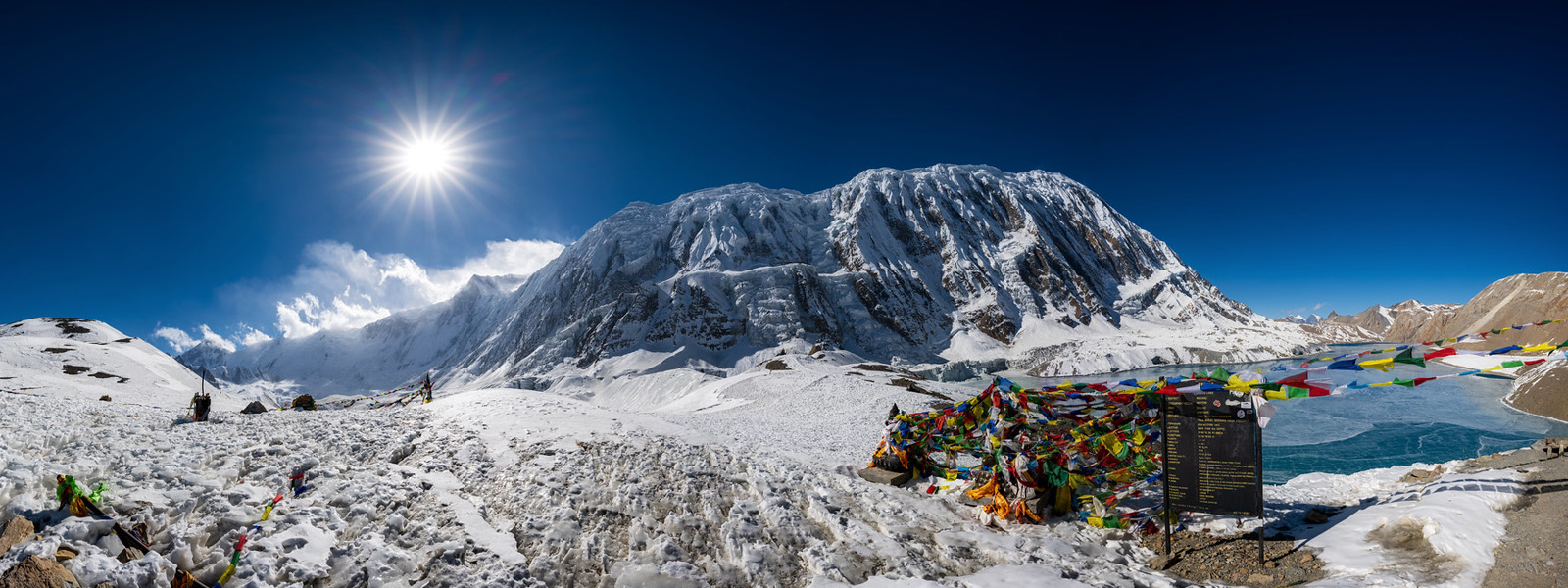
Thorong La at 5,416 metres is the highest point of the Annapurna Circuit and the trek's defining day. We've crossed it 70+ times across both seasons. Here's the hour-by-hour from the 04:30 walk-out at Thorong Phedi to the 16:00 collapse in Muktinath, with the failure modes and how to avoid them.
The night before — at Phedi
You're at Thorong Phedi, 4,450 metres. Two lodges — Thorong Base Camp Hotel and Yak Donald's (named after the inflatable Pikachu on its roof — yes, really). Both fill by 13:00 in October. If you arrive after 14:00 you're either in the dining hall or pushing 90 minutes more to High Camp (4,880 m).
The High Camp question is worth thinking through. High Camp cuts pass day by 90 minutes, but you sleep 430 m higher. The HRA's data on AMS rates: sleeping at 4,880 m on an unacclimatised body increases moderate-AMS incidence by ~40% versus sleeping at 4,450 m. Unless your Manang acclim hike (Ice Lake at 4,600 m) felt easy, sleep at Phedi.
Eat by 18:30. Dal bhat with extra rice. Drink one litre of water with dinner. Pack the day pack tonight — no headtorch fumbling at 04:00. Set the alarm for 03:30.
03:30–04:30 — Wake and walk
It's -8 °C outside the bag, -2 °C inside the room. Get the down jacket on before swinging your legs out. Tea and biscuits in the dining hall — lodges have it ready by 03:50. Don't force porridge if your appetite is gone; the headache will only get worse.
Headtorch on, layered up (base + fleece + down + hardshell + wind pants), liner gloves AND insulated mitts, buff over the face. Step outside. Stars. -10 °C. You'll see other headtorches already moving up the switchbacks above the lodge — start walking.
04:30–07:00 — The first climb
The trail climbs in steady switchbacks for 90 minutes from Phedi to High Camp (+430 m). Pace is slow — 50 steps, 30 second rest, repeat. If you're out of breath, you're walking too fast. The 30-second-rest rhythm is the trick that gets normal trekkers over this pass without AMS.
High Camp at 4,880 m is where Phedi sleepers meet High Camp sleepers — the trail merges. Quick tea at the High Camp lodge if you need to refuel. Don't sit longer than 5 minutes; you cool fast.
07:00–10:30 — The climb to the pass
From High Camp the trail gradient eases but the altitude makes it brutal. ~3 hours of slow grind up exposed scree, through what locals call "the false summits" — three apparent passes before the real one.
Sunrise hits around 06:30. The whole eastern Annapurna massif (Annapurna II, III, IV) glowing pink behind you. Most trekkers stop here for photos; budget five minutes, no more. The longer you stop, the colder you get, the harder the rest of the climb.
Microspikes go on if there's fresh snow or icy patches — common Nov–April. Rent in Kathmandu or Pokhara for NPR 200/day. The few times we've sent trekkers up without spikes in November, they slipped within the first 200 m on the descent.
10:30–11:00 — Thorong La summit (5,416 m)
You arrive at a cairn covered in prayer flags, a stone tea hut (open only in peak season, NPR 200 for tea), and the Annapurna panorama behind you and the brown-and-snow Mustang plateau ahead. Dhaulagiri (8,167 m) across the Kali Gandaki gorge is the trek's defining photo.
Stay 20 minutes maximum. The wind tears across the pass at 40–60 km/h every season; the windchill alone is -25 °C even in October. Eat a Snickers, drink water (insulated bottle — yours has been freezing in your daypack), photos, descent.
11:00–16:00 — The descent (the bit everyone underestimates)
This is the part of the day people get wrong. 1,656 metres of descent to Muktinath, mostly on loose scree, in 4–5 hours. Knees take a beating. The first 300 m off the pass is steep enough that we see falls on every group trip — bruises, twisted ankles, occasionally a broken wrist.
Trekking poles short for downhill. Microspikes stay on for the first 90 minutes. Take the switchbacks rather than the straight scree shortcuts — looks slower, is faster, no rolled ankles.
The gradient eases at Charabu (~4,200 m). Quick tea stop at the seasonal hut. Re-apply sunscreen — UV at altitude burns through cloud, and your face has been exposed for 4 hours.
Final stretch through brown Mustang scrubland into Muktinath. The transition from snow at the pass to dust + sun in 3 hours is one of the trek's most memorable weather shifts.
16:00 — Muktinath
You arrive at Muktinath (3,760 m) — soft beds, hot showers, Indian food, ATM, even Wi-Fi. Hotel Bob Marley is the legendary Circuit lodge here (reggae through the dining hall, NPR 1,500 twin); Hotel North Pole is the cleanest mid-range alternative. Book ahead in October.
By the time you collapse on the bed your watch reads 9–10 h on the move, ~15 km, +1,000 m gain and -1,656 m loss. You've crossed the highest pass on any major Nepal trek and the worst is behind you.
The failure modes
AMS on the climb (~25% of unsuccessful crossings). Symptoms: headache scoring 4+ on the AMS checker, nausea, ataxia (stumbling). Treatment: descend. Period. The closest aid is back at High Camp; do NOT push on hoping to summit.
Hypothermia on the descent (~20%). Damp base layers from the climb + summit windchill + 4-hour cold descent. Strip the wet layer at the pass, dry base on, down on top. We've evacuated four trekkers from this descent for hypothermia in the last seven years — all of them insisted they were fine at the summit.
Rolled ankles / falls on the descent (~30%). The scree gets all the headlines but the steep first 300 m off the pass is where most falls happen. Microspikes + short poles + switchback discipline = no falls.
Snow blindness (~15% in spring). Cat-3 minimum sunglasses, cat-4 is better. Worth the USD 30 upgrade.
The acclim that decides this day
Successful pass days happen because of decisions made 72 hours earlier. The single biggest predictor in our records is whether the trekker took the full 2-night acclim at Manang AND did an active hike (Ice Lake at 4,600 m is best). Skip either and pass-day success rate drops from ~95% to ~70%.
Use Manang actively, not passively. Ice Lake hike, Praken Gompa lama blessing, attend the HRA AMS talk at 15:00, drink 4+ litres of water. Diamox 125 mg twice daily starting from your second day in Manang.
Pass-day pack contents
- 2 L water in insulated bottle or thermos (Nalgenes freeze)
- Headlamp + spare battery in inner pocket
- Down jacket (in the pack until summit)
- Liner gloves + insulated mitts
- Buff over face / balaclava
- Cat-3+ sunglasses
- Sunscreen SPF 50+ + lip balm SPF
- Snacks: 3× chocolate bars + 2× energy bars + nuts
- Microspikes (Oct–Apr)
- Trekking poles (foldable, in hand from the start)
- First-aid mini kit + Diamox + Ibuprofen
- Phone / camera (cold drains batteries — keep close to body)
About 4.5 kg total. Porter (or your duffel on a yak from Phedi) carries everything else.
Bottom line
Thorong La is the highlight of the Annapurna Circuit and the day that justifies the whole trek. It's harder than the average AC blog admits — 9–10 hours, brutal cold, brutal descent — and easier than fear-content blogs make it sound. With proper Manang acclim, the right kit, and a 04:30 start from Phedi, the success rate is around 90%. Without those, it's a 50-50 coin flip with a helicopter fare on the losing side.
Plan the rest of the trek around making this day work.