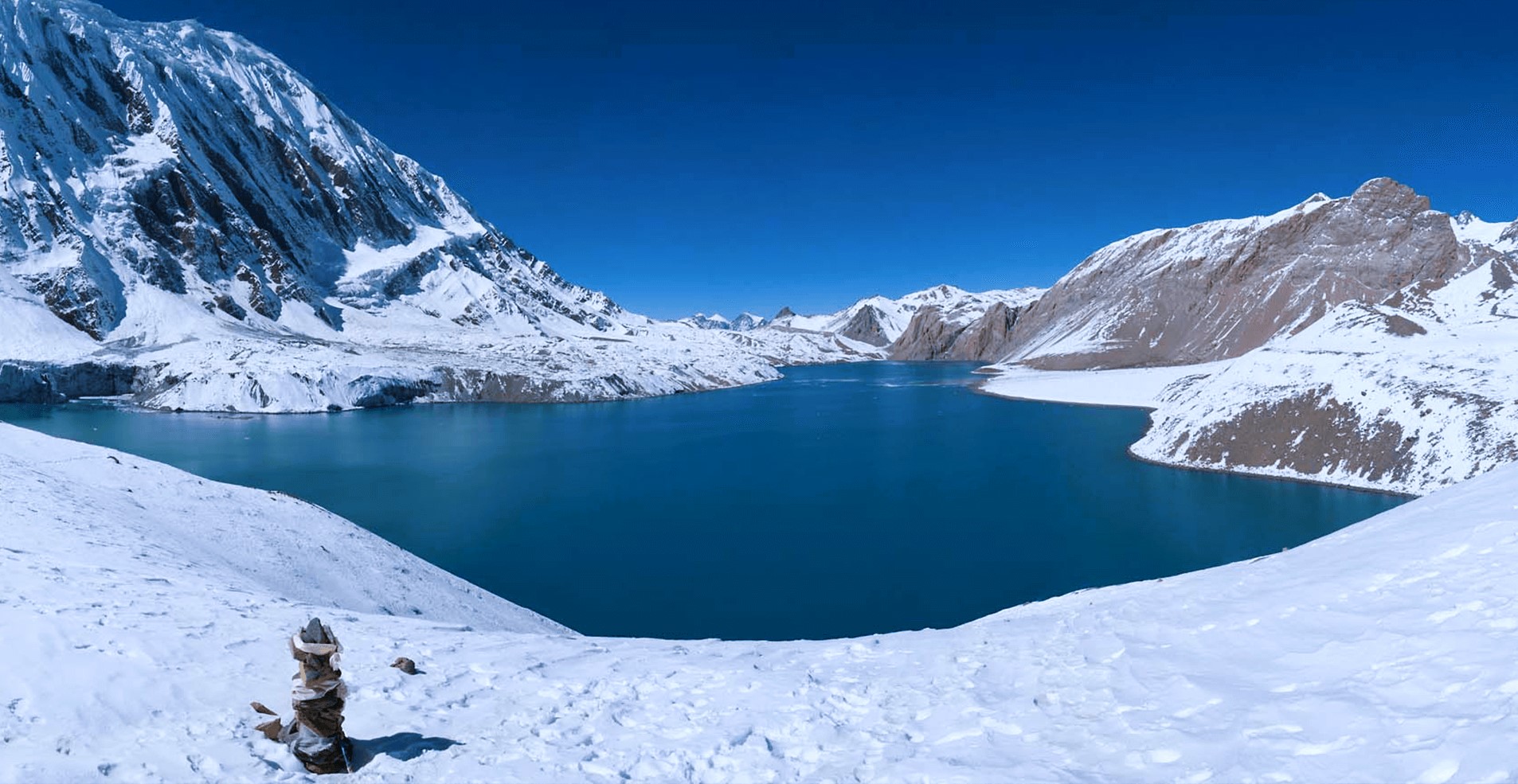
Tilicho Lake at 4,919 metres is the most-asked Annapurna Circuit question after the pass: do I add it or not? Three extra days, one of the most exposed trail sections in Nepal, and a frozen turquoise lake that looks like nothing else on the trek. Here's whether it's worth your three days.
The short answer
Yes if you have prior 4,500 m+ experience, you're already taking 12+ days for the Circuit, and you can deal with one moderately scary scree traverse.
No if this is your first Himalayan trek, you're nervous on exposure, or you're trying to squeeze the Circuit into a sub-10-day window without acclimatisation experience.
What you actually do
The Tilicho detour adds 3 days to the standard 12-day Circuit, branching off the main trail at Manang. The route:
- Day 1 of detour: Manang (3,519 m) → Khangsar (3,756 m) → Shri Kharka (4,045 m). ~5 h walking. Easy gradient through yak pastures. Stay at Shri Kharka Lodge — leave heavy bags here for the lake dayhike tomorrow.
- Day 2 of detour: Shri Kharka → Tilicho Base Camp (4,150 m). ~4 h on the exposed scree traverse — the trail's defining and scariest stretch. Single lodge at TBC (Tilicho Base Camp Hotel); 20 rooms, fills by 14:00 in peak weeks.
- Day 3 of detour: Tilicho Base Camp → Tilicho Lake (4,919 m) for sunrise → back to Shri Kharka. ~10 h round trip. The lake day is the photo, the headache, and the payoff in one.
You rejoin the main Circuit by descending from Shri Kharka to Yak Kharka on day 4 of the detour (~7 h, mostly downhill), then continue as normal: Yak Kharka → Thorong Phedi → Thorong La → Muktinath.
The lake day
03:30 alarm at Tilicho Base Camp. -10 °C outside the bag. Down jacket on first. Headlamp, four layers, gloves, buff. Walking by 04:00.
The trail climbs in steady switchbacks behind the lodge — 770 metres of gain over 3 hours. Pace is slow, like the Thorong La climb. The path crosses several false ridges; you'll see the lake only at the final ridge.
Sunrise hits the surface at ~05:45. Tilicho Peak (7,134 m) reflects in the still water — the trek's defining photo. Stay 30 minutes; the wind picks up by 08:00 and the temperature drops as the sun lights up the western glacier.
Descent to Tilicho Base Camp is fast (~2 h), grab your stashed bag, then onwards to Shri Kharka (~3 h). 10 hours total on the move. Sleep low.
The exposed traverse — the bit that scares people
The Shri Kharka → Tilicho Base Camp trail crosses a landslide-prone slope above the Khangsar Khola valley. ~1 hour of the 4-hour day is on this section — narrow path, loose scree, big drop to your right. Multiple sources call it Nepal's most dangerous popular trail.
The reality: it's manageable for any trekker who's comfortable on exposure. We've taken first-time trekkers across it without incident. The actual rules:
- Start by 06:00. Afternoon winds dislodge rocks; the danger window is 11:00–17:00. Most groups arrive by 10:00.
- Watch for falling rock. Look up periodically. If you hear "rock!" called from above, freeze and look up — don't run.
- Microspikes Oct–April. Icy patches make the loose scree treacherous.
- No bag-juggling on the traverse. Sort your pack before you start the exposed section; do not try to fish water out mid-traverse.
The acclim benefit
An underrated reason to add Tilicho: it's the best acclim hike on the Circuit. The Manang → Shri Kharka → Tilicho Base Camp → Tilicho Lake profile is a textbook climb-high-sleep-low ladder. Trekkers who do Tilicho before Thorong La cross the pass at a ~98% success rate vs ~92% for the no-Tilicho group in our records.
If you'd otherwise take the Ice Lake hike from Manang for acclim, Tilicho replaces it with a better one + a side-quest summit. Skip Ice Lake if you do Tilicho.
The Tilicho Base Camp lodge problem
One lodge. 20 rooms. Fills by 14:00 in October. If you arrive at 16:00 you sleep on the dining hall floor (NPR 500, communal blanket) or you walk back to Shri Kharka in the dark (3 h, dangerous).
The fix: leave Shri Kharka by 06:30. Even slow trekkers arrive at TBC by 11:00. Plenty of beds at 11:00; none by 15:00.
When NOT to add Tilicho
- You have less than 12 total days for the Circuit. Tilicho needs proper Manang acclim first; rushing it dramatically raises AMS risk on the lake day.
- You're scared of exposure. The traverse is fine for most people but genuinely uncomfortable for ~10% of trekkers. If you'd be miserable, skip it.
- You're trekking outside Mar–May or Sep–Nov. The traverse is technically open year-round but snow + ice make it significantly more dangerous in winter, and the lake itself is solid ice from November to April.
- This is your first Himalayan trek. ABC or the standard Circuit are better first treks. Add Tilicho on a return trip.
What it costs
Three additional trekking days at NPR 3,500–5,000/day = NPR 10,500–15,000 (~USD 80–110) per trekker. No new permits required — your ACAP covers the Tilicho area. The single Tilicho Base Camp Hotel charges NPR 1,500 twin (premium over other lodges due to monopoly).
Itinerary fit
The cleanest way to add Tilicho is the standard 15-day variant — see our Annapurna Circuit Tilicho variant for the day-by-day. The Reddit-walked Nepali Fast 9-day variant also includes Tilicho but pairs it with brutal Pokhara-to-Pokhara pacing; only attempt that if you've done a 4,500+ m trek before.
Bottom line
Tilicho is the best detour on the Annapurna Circuit. The lake is one of the highest in the world, the dawn photo is unforgettable, and the acclim profile improves your Thorong La crossing odds. The exposed traverse is the entry fee — manageable for most trekkers, scary for some. Decide based on whether you're OK with one hour of exposed walking, not whether you have the legs (you do).